Temecula Roof Pros: Roof Replacement, Reroofing & Leak Repair
Expert residential and commercial roofing services. Free on-roof inspection, photographs of every slope, and a written fastening schedule with each estimate.
- ✓Licensed California C-39 roofing contractor, insured and bonded
- ✓Free on-roof inspection with photographs of every slope and the attic
- ✓Fastening schedule and wind class written into every proposal
- ✓Se habla español
Why Temecula Chooses Temecula Roof Pros
- ✓We separate the tile problem from the underlayment problem before quoting, because on a nineties Temecula roof those are two different jobs at two very different prices.
- ✓We inspect from the attic as well as the surface. Whether the felt at the eave still bends is the finding that sets your scope, and you cannot see it from the driveway.
- ✓We hose-test to prove where water is entering rather than guessing from where the ceiling stained, because water under tile travels sideways along a batten before it drops.
- ✓Our scopes name the underlayment and the square footage it covers, which is the only way one repair quote can honestly be compared with another.
- ✓We match cracked tile out of salvage stock by profile and color, so a point repair does not announce itself from the street or to an architectural committee.
- ✓We price one whole-roof relay against the section relays you would otherwise buy over several winters, and hand you the arithmetic instead of the conclusion.
How It Works
Free Inspection, Slope by Slope
We get on the roof rather than looking from the driveway. Shingle tabs get a hand uplift test on every elevation. Tile gets counted: loose in the lug, cracked, out of headlap. Then edge metal, ridge and hip, valleys, penetrations and vent throats, followed by the attic, where nail shiners, daylight at the rake and wind-washed insulation tell you what the surface hides.
A Written Fastening Schedule
Your proposal names products and how they are held down: nails per piece and where they land, clip or adhesive at the perimeter, underlayment type by elevation, edge metal spacing, and ridge detail. Two bids naming the same shingle can buy very different roofs, and the difference lives in that schedule. It is also how you hold us to what we promised.
Sequenced Installation
Tear-off, then the deck gets inspected and any soft sheathing replaced before anything covers it. Underlayment goes down with cap nails, not staples. Edge metal is bedded and fastened tight. Field goes on, then the perimeter and rake courses get their extra fasteners and hand-sealing, and ridge and hip caps close it out over a metal riser.
A Walkthrough After the First Wind
New roofs get judged by weather, not by the invoice date. After the first strong offshore event we come back, walk the perimeter and the ridge, and check that nothing moved. If a fastener or a closure needs attention it gets handled under the workmanship warranty, and you get photographs from that visit too.
Temecula Roofing: Every Service

Residential Roof Installation
A roof going onto bare deck in Temecula is designed around two things that have very little to do with shingles: which fire hazard zone the parcel sits in, and how hard the wind comes through the pass on an autumn afternoon. California sets the floor by zone and the residential code is blunt about it.

Commercial Roof Installation
Temecula's commercial stock is business-park and light-industrial: single-story shells along Enterprise Circle and Jefferson Avenue, retail centers, medical offices, and hospitality out toward the wine country. Almost all of it is low-slope membrane, and almost all of the failures we are called to start at an edge or a curb.

Roof Replacement
A reroof out here gets graded after the first hard Santa Ana, not on the day the dumpster leaves. Temecula sits at a low pass through the Peninsular Ranges, so moving air is the normal state of the valley, and attachment decides whether a new roof stays new.

Roof Repair
Most Temecula repair calls are tile, and tile repair is a different trade from shingle repair. The tile itself is usually fine.
Asphalt Shingle Roofs
Shingle is the minority covering on Temecula streets and it can be the right one, particularly on complex framing where tile weight or a low-pitch section makes stone a poor fit. The variable that decides how it performs here is not brand.
Cool Roof Installation
Temecula sits in California Energy Code climate zone 10, which puts it inside the band where a cool roof is prescriptive rather than optional. For a tile valley like this one, the exemptions are the interesting half of the rule.

Fascia & Soffit
Fascia and soffit look like trim and behave like structure. The fascia carries your gutters and closes the ends of the rafters; the soffit is the intake side of the attic ventilation system.

Flat & Low-Slope Roofing
Low-slope work on Temecula houses is usually not a whole roof. It is a porch, a second-story deck, a tucked-in addition, or the flat pan behind a parapet on a tile house.

Hail Damage Roofing
Hail is a real peril in Temecula but a secondary one, and being straight about that saves people money. Small graupel and pea-size stones reach this valley in cold winter systems; the destructive plains-style event that flattens a roof in ten minutes is not the local pattern.
Insurance Claim Help
Wind claims are argued differently from hail claims, and that is worth knowing before you pick up the phone to your carrier. There are no obvious dents to point at.

Metal Roofing
Metal is the strongest covering available for a wind-exposed slope, provided you buy the right kind. There are two families and they behave nothing alike here, so this page is mostly about talking you out of one of them.

Roof Leak Repair
If water is coming in right now, put a bucket under it, pull anything valuable out from underneath, and photograph the ceiling before it dries. Then call.

Roof Skylight Installation
A skylight is a hole in the water plane with glass over it, so everything depends on the metal around it. Get the flashing right and a good unit outlives the roof it sits in.

Storm Damage Restoration
The storm that damages roofs in this valley is usually a dry one. A winter system with a strong pressure gradient, or an offshore event pushing through the gap for two days, does more here than any single downpour.

Tile Roofing
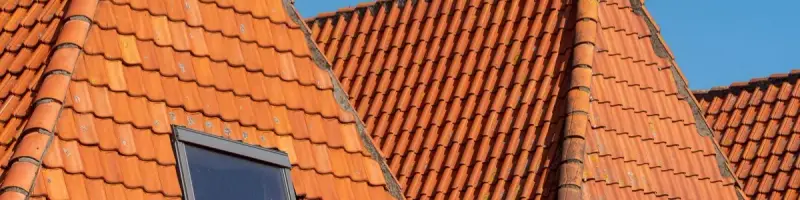
Most of Temecula wears concrete tile, and out here the useful question about it is not how old it looks. It is whether the pieces are still held down.

Wind Damage Roofing
Wind does not push down on a roof; it pulls up on it. Air accelerating over a ridge or around a corner drops pressure on the outside surface while the attic stays near ambient, and the difference tries to peel the covering off.
What Temecula Customers Say
Lost about twenty tiles off the west hip in a January wind. Two companies quoted a full tear-off. These guys got on the roof, showed me photographs of the underlayment still being sound, reset and refastened the hip and rake with clips, and replaced the drip edge. A third of the price and it has not moved since.
We had a stain in the hallway ceiling that three people had looked at. They found it was the chimney flashing on the windward side, surface-caulked by whoever did it last. They cut a proper reglet, ran new step and counterflashing, and added a cricket. Explained every step and the wall has stayed dry through two winters.
Asked for a quote on coating my tile roof because a door-knocker told me it needed sealing. They told me straight that a coating does nothing for wind and would make future repairs worse, then priced a section relay instead. Appreciated being talked out of spending money on the wrong thing.
Full reroof on a 1990s house. The estimate actually listed nail counts, the underlayment by slope and the edge metal spacing, which no other bid did. Crew replaced two sheets of soft plywood they found at tear-off and showed me before covering it. They came back after the first Santa Ana to check the ridge.
Almost every Temecula roof repair call comes down to one question, and it is not price. Is this a tile problem or a paper problem?
A cracked piece, a split vent collar, a length of wall flashing somebody surface-caulked instead of letting into a reglet: those are an afternoon, and the rest of the roof is none of your business that day.
Underlayment that has reached the end of its service life is a different animal, because the only route to felt is to take the tile off to get at it. So that is the finding we go up to establish first, before anyone writes a number down.
Temecula incorporated on December 1, 1989 with roughly 27,000 residents and had about doubled that by the 2000 census, and the Redhawk tracts were annexed in 2005. That growth curve is the most useful thing to know about roofs here: most of the city's housing came out of one short building window, so it is aging on one schedule.
Walk Vail Ranch, Paloma del Sol or the earlier Redhawk phases and you are looking at concrete tile in flat, low and S profiles over thirty-pound felt laid in the nineties. Harveston and Wolf Creek went up in the 2000s and sit a decade behind that.
On that assembly the tile is not the waterproofing. It is the wear layer: it takes the weather, shades the deck and sheds the bulk of the water, while the felt tacked to the plywood underneath is the actual membrane. Concrete tile will outlive most of the people who paid for it.
Organic felt, sitting on a deck in full sun from May through October year after year, generally gives twenty to thirty years, and gives less than that on the south and west planes. It does not fail dramatically either. It loses its oils, goes the color and texture of a cracker, and stops sealing around the nails holding it down.
The local weather pattern then hides all of that for most of the year. Temecula sees roughly a foot of rain in an average year and nearly all of it lands between December and March, with June effectively dry.
A roof can spend six or seven months under nothing but sun and moving air, with no water to reveal what either one did. Then the first real system of the season tests every square foot of felt at once and finds whichever foot quit in August, which is why this trade's phone rings in a two-week burst.
September is a better month to have a roof looked at, and a cheaper one.
Wind belongs in the story as the thing that starts the clock, not the thing that leaks. Marine air is drawn in through the Rainbow Gap toward this valley on most afternoons, and in late fall and winter a Santa Ana reverses the direction and pushes hard the other way.
Field tile resting on a batten with one nail or none is held by its own weight and its neighbors, so a gust lifts the leading edge and walks a piece out of its lug. Nothing breaks. But the headlap is gone, and the felt under that opening now takes sun and rain directly.
A tile displaced two winters ago and never reset is usually why one plane fails years ahead of the other three.
Which is why the honest unit of a Temecula roof repair is not the leak. It is the square footage of felt that has to come off to reach it, plus the hand labor of destacking and restacking tile to get there. Three tiers cover nearly everything here.
A point repair stays local to the defect: a vent boot, a reglet cut into the stucco and counterflashed properly, a dozen cracked pieces matched out of salvage and refastened. A section relay strips one plane to the deck and re-papers it with the same tile going back down.
A whole-roof relay does all of it once, reusing tile you already own.
Here is the part that costs us work. If your house is fifteen years old or younger and one stain appeared after one storm, do not buy a relay. On that roof the overwhelming odds are a single failed detail, a boot or a packed valley or a skylight head flashing, and the felt has years left in it.
Fix the detail, keep the photographs, look again in five years. The opposite case is just as real. If we have relayed two planes for you across three winters on a nineties roof, stop buying mobilizations. Everything up there is the same age, and one whole-roof relay will cost you less than the fourth phone call.
About Temecula Roof Pros in Temecula, CA
We work in a city whose roofs are very nearly all the same age, and that single fact has made this a repair outfit more than a replacement outfit. Temecula went from a crossroads to a city of tens of thousands inside about fifteen years, and the covering that went on through that boom was concrete tile over felt.
The tile is mostly fine. The felt is the part carrying a clock, and telling the two apart is the whole skill here.
So an inspection is built around that question instead of around a sales call. We get on the roof and we also get into the attic, because the underside reports what the surface will not: whether water tracked along a batten line, whether the felt at the eave still bends, where a fastener missed framing entirely.
We photograph the failure before it gets covered, we hose-test when the entry point is genuinely in doubt, and the scope you receive names the underlayment, the area it covers and the flashing metal being replaced rather than re-sealed.
We hold a California C-39 roofing license, we are insured and bonded, we are members of the Western States Roofing Contractors Association, and the work carries a written workmanship warranty.
We also say no in writing, which is the part worth judging us on. We have talked homeowners out of relays their roofs did not need, refused to spray a coating over tile and call it sealing because it does nothing for the felt underneath and makes the next repair take ten tiles instead of one, and told people with one stain and a fifteen-year-old roof to swap a vent collar and look again in five years.
The wrong customer for us is the one who has already settled on a new roof and wants an estimate that agrees. We will set the repair next to the replacement with the photographs between them, and if the repair wins on the evidence we will say so out loud. If that conversation is unwelcome, there are companies in this valley happy to skip it.
Recent Projects Across the Temecula Valley
Full gallery →


Service Areas
Temecula Roof Pros serves Temecula, CA and surrounding communities including:
Commercial Roofing in Temecula & Across the Temecula Valley
We roof and maintain the business-park and light-industrial stock along Enterprise Circle and Jefferson Avenue, plus retail centers, medical offices and hospitality property out toward the wine country. Almost all of it is low-slope membrane on an exposed pad, which makes perimeter and corner uplift the governing design issue rather than an afterthought.
Wind separating over a parapet produces the highest negative pressures on the building exactly where a uniform fastening pattern is weakest, so we densify fastening in those zones and specify tested edge metal. Occupied buildings set the schedule: we section the work, keep a dry area at all times, and coordinate roof access and noise with tenants.
- ✓60 and 80 mil TPO, EPDM and two-ply SBS modified bitumen assemblies
- ✓Fastening densified in ASCE 7 perimeter and corner zones, not run uniformly
- ✓Edge metal specified and tested to the ANSI/SPRI ES-1 standard
- ✓Fully adhered assemblies where the deck allows, so the sheet cannot flutter
- ✓Curb, sleeper and pipe flashings with clamped collars instead of mastic mounds
- ✓Tapered insulation to build fall, sumped drains and sized overflow scuppers
- ✓Recover over a sound, dry deck where core cuts justify skipping a tear-off
- ✓Twice-yearly maintenance: seam probing, drains, pitch pans, written photo report
Frequently Asked Questions
Is my Temecula roof repair a tile job or an underlayment job?
Three things usually answer it before we quote. Age: a roof papered in the nineties is at or past the service life of thirty-pound felt, while a 2000s roof probably is not. Pattern: one stain under one penetration points at that penetration, while separate stains across the same plane point at the sheet. Then the attic, which settles most arguments.
From underneath you can see whether water tracked along a batten or dropped straight off a nail, and whether the felt visible at the eave still bends or crumbles between two fingers. Where the entry point is still in doubt we hose-test, starting low on the plane and working up.
Does a roof repair need a permit in Temecula?
Ask the city, because the city decides where maintenance ends and a reroof begins, and that is a short call to Building and Safety rather than a judgment we should be making for you.
What we can tell you is what the city's roofing page asks for once you are in permit territory: the application goes through its online system, you supply the Cool Roof Rating Council number for the product being installed along with the energy compliance form, and if the color or the design is changing, Planning becomes part of it too.
An inspector looks at the installation before the permit closes. Addresses in French Valley, Winchester and other unincorporated pockets go through Riverside County instead.
Can you re-paper only the slope that is leaking?
Yes, and on a hip roof with four separate planes that is often the right call. A section relay has a real boundary: we strip inside that plane to the deck, replace any soft sheathing, run new underlayment, and set the same tile back with proper fastening at the rake and the eave.
What you buy is one plane's worth of service life. The thing to weigh is that setup, tile destacking, disposal and crew mobilization repeat every time you do it, so two or three section relays on one roof generally add up past a single whole-roof relay. We price both and put the numbers side by side.
Why did the ceiling only stain after the December storm?
Because the dry season hid the defect and the first storm tested it. Six months of sun and offshore wind can finish a sheet of felt or back a fastener out without producing a drop of water indoors.
Then a December system arrives with enough volume, and enough wind to push water uphill under a lap, and the evidence shows up on your ceiling. The stain is new; the failure is months old.
It is also why a stain that appears in the first storm of a season very often grows in the second one, and why we would rather inspect a roof in the fall than triage it in the rain.
Why are two repair quotes for the same leak so far apart?
Usually because they describe two different jobs and only one of them admits it. A quote covering resetting tile and sealing the visible area is priced on the tile. A quote that includes lifting the field back and replacing underlayment across the plane is priced on the paper. Both can be honest.
They fix different things and they last different lengths of time. Read each one for the underlayment line, the area that line covers, and whether flashing metal is being replaced or re-caulked. A scope that does not name those three cannot be compared with anything, which is sometimes the point of writing it that way.
When does repairing a tile roof stop being worth it?
When the tile is what is failing rather than the felt. Concrete tile that is spalling, delaminating at the edges or cracking under a careful foot will not survive being lifted and set back down, so a relay on that roof spends labor handling a material that cannot come through the handling.
The other stopping point is arithmetic rather than condition. Once separate planes have needed work in consecutive winters, the roof is telling you the sheet is finished everywhere and that spot work has turned into a standing expense. Those are the two cases where we quote a new covering instead of a repair.